Roshd — Multi-Tenant B2B SaaS Platform
A unified, schema-isolated educational ecosystem powering Academies and Teachers via Strategy Patterns and dynamic CNAME/Sub-domain routing.
Video Demonstration Showcase
Interactive Video Showcase Coming Soon
We are recording a voice-over walk-through of Roshd's primary features, dashboard modules, and server operations. In the meantime, explore the complete system architecture details below!
Project Overview
Key Capabilities
PostgreSQL Schema Isolation
SecurityEnforced physical data isolation by routing each tenant organization to a dedicated PostgreSQL schema, preventing cross-tenant data leaks.
Strategy Pattern Product Registry
ArchitectureShared a single core Django backend to serve two fundamentally different operational modes (Academy and Teacher platforms) without code duplication.
Concurrency-Safe Internal Wallet
FinTechDesigned a double-entry ledger database schema where balance mutations are guarded with unique idempotency keys and row-level locking (`select_for_update`) to prevent race conditions during billing transactions.
Asynchronous Provisioning Pipeline
DevOpsImplemented a Celery/Redis background worker system that spins up new tenants, creates schemas, executes migrations, and configures default RBAC data in under 30 seconds.
Next.js 14 Turborepo Monorepo
FrontendDeveloped a monorepo workspace containing 4 client applications, sharing core authentication, UI styling packages, and custom ESLint security plugins.
Real-Time Systems & WebRTC
StreamingIntegrated WebRTC for live lectures and Server-Sent Events (SSE) for instant, lightweight client-side notifications and status alerts.
Automated Subdomain & Custom CNAME Provisioning System
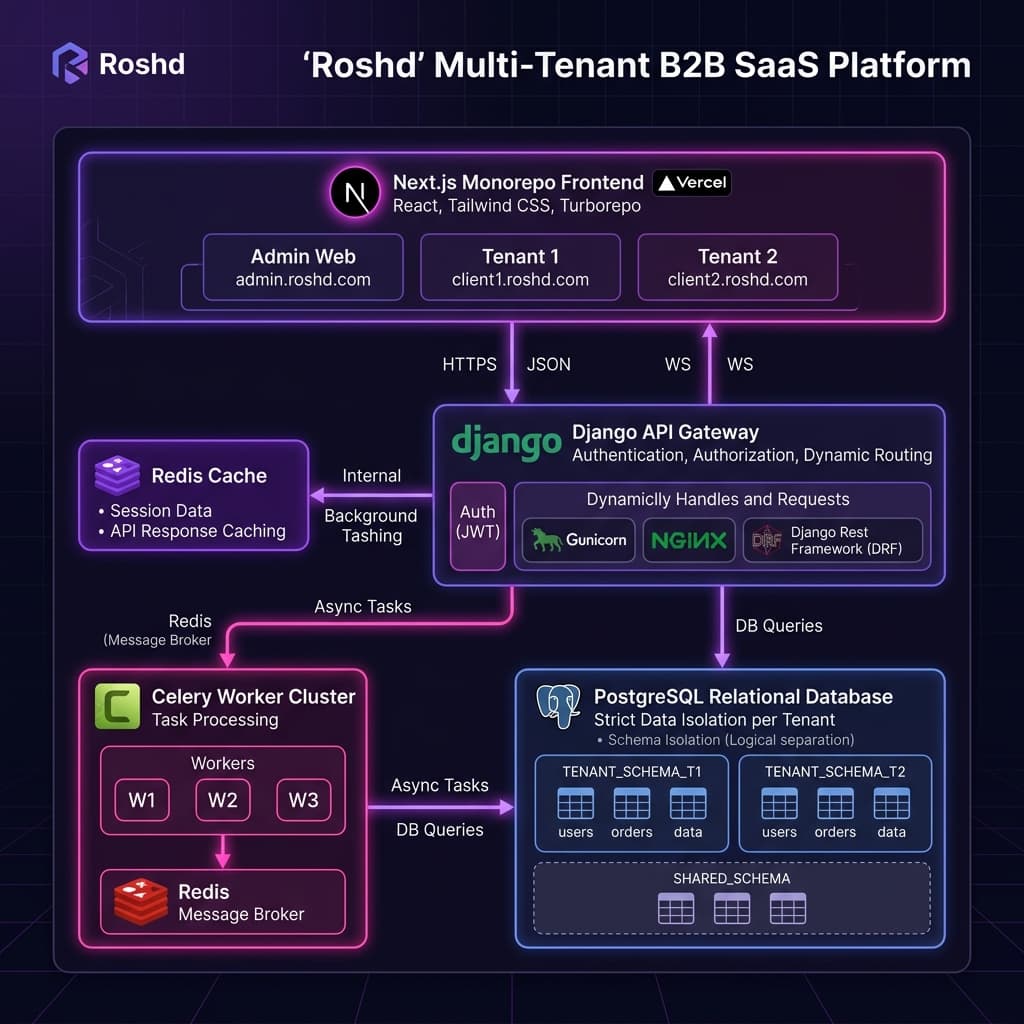
How Roshd dynamically routes requests to isolated PostgreSQL tenant schemas based on the request host name:
DNS Routing
The server configures a wildcard DNS record (*.roshed.tech) pointing all subdomains to our central application proxy.
Custom Domain Binding
Users can add their custom domains (e.g., learn.myacademy.com) by pointing a CNAME record to cname.roshed.tech.
Django Host middleware
On every incoming request, middleware parses the HTTP Host header, resolves it against the tenant domain registry, and fetches the associated tenant metadata.
Dynamic Search-Path Switcher
The middleware invokes a custom DB router which sets the PostgreSQL connection search path (`SET search_path TO tenant_schema_name`), routing all SQL queries to that tenant's database in real-time with zero overhead.
Automatic SSL Provisioning
The platform utilizes a Cloudflare/Nginx reverse-proxy setup that dynamically provisions Let's Encrypt SSL certificates for newly mapped custom domains.
Interactive Architecture Flow
Hover or click on the system modules to inspect their dynamic interactions and roles within the product stack:
Cloudflare DNS Proxy
Handles incoming wildcards (*.roshed.tech) and custom CNAME mappings dynamically.
Blueprint Sketch
Technical Challenges & Resolutions
Preventing race conditions and balance discrepancies in concurrent wallet mutations.
Implemented a double-entry accounting ledger system. Every transaction flows through a centralized balance service wrapping DB transactions with row-level locks (SELECT FOR UPDATE) and unique idempotency keys generated on the client. If a request is retried, the system returns the cached transaction result without modifying the wallet balance twice.
Managing database migrations across hundreds of tenant schemas without downtime.
Wrote a custom Django management wrapper that executes migrations sequentially or in parallel batches. The system utilizes Celery workers to run migrations schema-by-schema during off-peak hours, keeping track of migration states in a central control plane and pausing automatically if a schema migration fails.
Development timeline & Story
Conceptualizing Multi-Tenancy
Researched multi-tenancy models (Shared DB vs. Separate DB vs. Schema Isolation). Chose the schema-per-tenant design to provide strict security for enterprises while keeping maintenance simple. Designed the strategy-pattern classes.
Building the Routing Core
Coded the Host middleware in Django to intercept requests, parse domains/subdomains, and update PostgreSQL search paths. Configured Nginx proxy rules to test wildcard routing locally.
Developing Wallet and Billing
Built the double-entry accounting ledger, subscription cycles, CRM leads tracker, and RBAC matrix. Integrated WebRTC for interactive class rooms.
Turborepo Setup & CI/CD
Configured pnpm workspaces and Turborepo for Next.js 14 apps. Orchestrated Docker files, Docker Compose, and Github Actions pipelines to deploy automatically to staging environments.
Interested in discussing similar system integrations?